VIEWPOINTS ARTIST JULIE SCHOENECKER
|
VIEWPOINTS ARTIST JULIE SCHOENECKER |
 |
| "I first think of visualizing
music as an activity, with the listener as participant, playing the visuals
just like somebody else plays the drums, or guitar." This is a quote from
the web page of Sandy Cohen
who created several courses in visual music she teaches at San Francisco
State University's Multimedia Studies Program. She goes on to say that,
to her, "The visualization of music is a field of study, an exciting new
interactive form of art, and a pleasing esthetic experience." Of course,
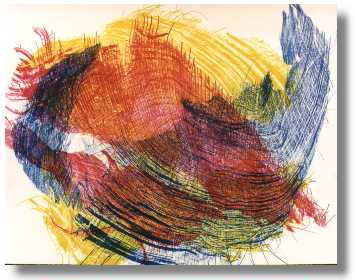
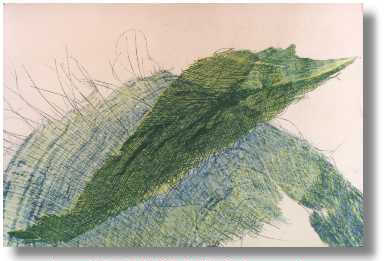
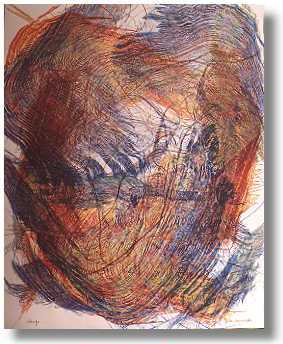
she happens to be talking about a relationship between computers and music. In this show, Julie Schoenecker was the computer and you are the player. The images came into Julie's head as she visualized the music which was their source and you can hear them with your eyes. |
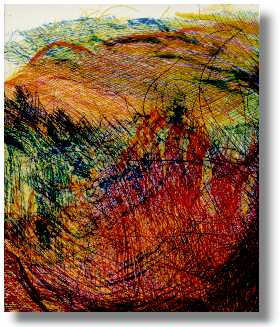 Caliente ©1998 Julie Schoenecker |
Color and texture are musical terms. One music professor says the words melody, rhythm, harmony, texture and form are the building blocks of music. All have a corresponding visual relationship and Julie uses all of them in this magnificent show. When you visit it, you can play or hear your own music as you view the images. Sandy Cohen tells us that artists have worked to externalize sound in visual form throughout history. In the 17th century, musical church services were adorned with color lenses and mirrors to enhance the music. Color organs and light show projectors have been around for about 100 years, inspiring many discussions about human nature and the artistic experience. Currently, animations on television and the internet are synched with sound so you can visualize the music. This show is a new 20th century approach. In this show, Julie Schoenecker produced her music and complex arrangements on paper using a technique called monotype. |
According to Julie, "Producing the work for this show has been the most fun I've ever had while doing art work. I always love making art but this Rhythms series has been sheer joy and exhilaration. I would often be in my studio by 4 a.m. bursting with ideas." Once a month, the magazine Jazziz arrived in her mailbox, together with a CD providing a sampling of the latest jazz. As she listened to this music, Brazilian and Caribbean jazz stimulated her ideas and expanded her ability to express them in color and texture. |
She is thankful to be a member of Viewpoints Gallery which gives her and the other member artists the freedom to explore and grow. "That freedom is incredibly stimulating. To be able to explore uncharted territories without regard for the commercial aspect is invigorating," says Julie. She recognizes that most galleries, operating for profit, want art that sells. If an artist has developed a popular expression, there is a strong compulsion by the gallery to have the artist continue producing similar work. She says "This is an understandable compulsion, since their bottom line is profit." Not so at Viewpoints. As a collective, Viewpoints chooses, explicitly, to display entirely new directions and works. This approach is unique! And who knows, maybe they will stimulate a new movement. In Julie's case, "My expression may be rolling along in one direction, switch to some new idea, then be stimulated in some way to go back to where I had been and continue from there. Years ago, in the early eighties, I produced several woodblock pieces which came from music. Ane of the them was entitled Chopin Mazurka. Another was Spring Symphony. My work is all of a piece. It comes, with honesty, entirely from somewhere through me. It just doesn't get there in a linear fashion. I hope you can look at Tango and the other compositions and feel the dance."  |
|
|Home| |Artists Page 1| |Artists Page 2| |Artists Page 3| |Current Show| |Makawao| |Gallery News| |Gift Shop| |Contact Viewpoints| |Privacy Policy| |Copyrights| |